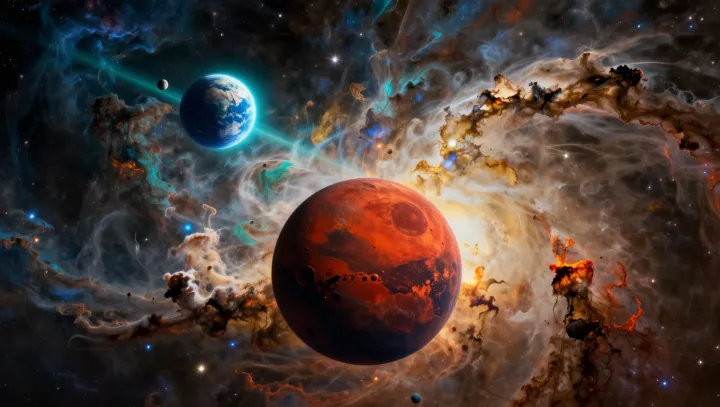
1 percent is generous: Mars's atmospheric pressure sits below that share of Earth's, the bluntest clue that a wet planet can be stripped bare. Rivers did not require a modern Earthlike blanket; early Mars likely had enough pressure and warmth for stable surface water. Not a permanent ocean. Dried channels, lake sediments, and altered minerals preserve that case.
Gravity mattered. Not alone. Mars's lower gravity eased escape, but solar radiation split water and carbon dioxide high in the atmosphere, while the solar wind drove ion loss through sputtering. Photochemical escape and sputtering acted like a server memory leak: molecules and ions crossed the system boundary until climate lost its buffer. Some carbon entered carbonates, clays, and polar ice. A thicker atmosphere could thus thin, then cross a climate threshold.
The missing air is not one bill with one debtor. Isotope ratios favor loss to space, and weakened magnetic shielding exposed the upper atmosphere to charged particles; mineral storage, however, means escape is not the whole ledger. This is a planetary failure log. Better measurements of noble gases, carbon isotopes, and buried carbonates would separate the missing reservoirs. The payoff reaches beyond Mars: resolve that ledger, and future observatories could distinguish a wet world's promise from an atmosphere already bleeding into space.