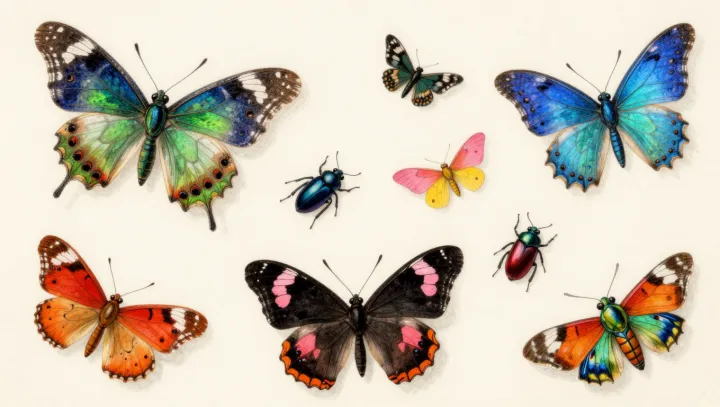
Color on a butterfly wing is less paint than architecture: as the surface tilts, one flash can turn from blue to dimness because ordered layers choose which wavelengths return to the eye. The trick is physical. Within each scale, chitin and air form nanostructures whose spacing sits near visible wavelengths, turning incident light into a selective display. No dye is required.
The apparent extravagance is economical. Pigments create color by absorbing portions of the spectrum, while structural color depends on interference: light reflected from separate chitin-air interfaces arrives either aligned or out of step. Aligned waves brighten one band. In multilayer stacks, constructive interference can yield saturated blues and greens without blue or green dye, while destructive interference suppresses competing wavelengths before they reach an observer. The geometry can also sort polarization, a feature studied for sensors and low-energy coatings.
That brilliance has a catch. When ridge arrays act as diffraction gratings, or when periodic lattices behave as photonic crystals, a shift in viewing angle changes optical path length and therefore hue, producing iridescence rather than a fixed coat of color. Angles rewrite the result. Some species soften that effect with disordered nanostructures, which scatter a favored band across many directions and make its signal more stable in flight. Not pigment alone. A wing becomes an optical argument, remade whenever light and sight exchange positions.