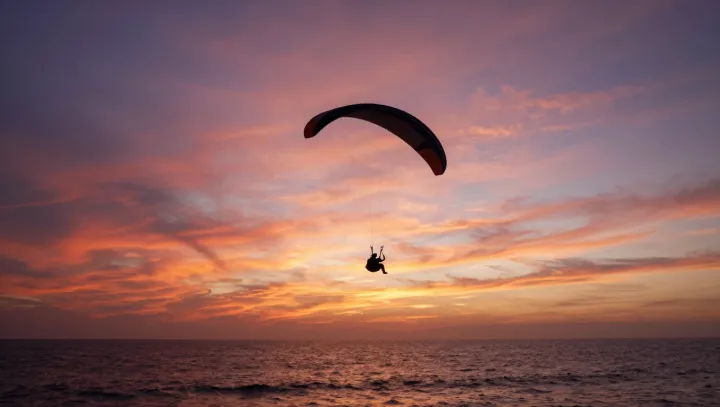
Deceptive is the hush cast across a runway when the sun sits low ahead of an arriving aircraft: what appears to be a softened field can become a sheet of reflected light, flattening markings, bleaching edges, and making the far end seem nearer or farther than it is. The eye can misread. During the shift from photopic to mesopic vision, retinal adaptation does not move on command; cockpit windows, wet pavement, haze, and a bright solar disc can produce veiling luminance, draining contrast from precisely the cues used to judge height and closure. That margin disappears fast.
Sunset is not harmless. Pilots do not lose depth perception as a switch flips; rather, glare can corrupt the binocular and motion cues that support a stable approach, while the brain must reconcile a luminous horizon with a runway whose centerline and threshold have lost their authority. Runway perspective is unforgiving. Approach lighting and a precision approach path indicator, or PAPI, supply external references, yet neither erases glare: a pilot still has to interpret color, angle, and apparent motion through a windscreen where scattering may turn a narrow error into a late correction. Procedures matter most here. Briefing the sun angle, using approved visors, cross-checking instruments, and refusing a rushed landing are not theatrical precautions; they preserve the small reserve between a controlled descent and a persuasive illusion. At day's dim edge, the runway asks whether seeing light is the same as seeing distance.