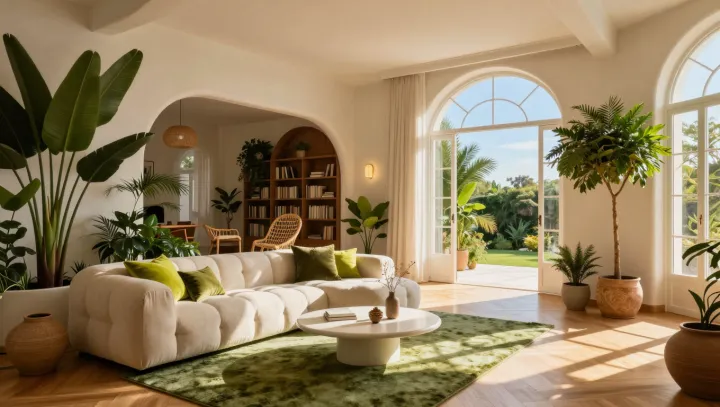
Glass wins the first impression. At a room's edge, daylight spills across the floor and pushes the visible boundary beyond the actual square footage. That is no accident. Floor-to-ceiling glazing increases visual permeability, allowing the eye to borrow distance from an exterior view while higher photopic luminance makes paint, stone, and timber appear cleaner. The price tag can mislead. You are responding less to costly materials than to the sensation that the room has more air, more reach, and fewer limits.
Plants do more work. Dense foliage reads as abundance because it adds layered form, irregular texture, and a sense that the room is maintained rather than merely furnished. Your brain takes the bait. Biophilia and attention restoration theory help explain why greenery can soften mental fatigue and make an interior feel more generous, even when the pots, soil, and plants cost little. Sparse decor can look intentional. A cluster of living leaves, however, suggests care, permanence, and access to space.
Scale beats spending. When broad glass offers prospect and plants provide partial refuge, prospect-refuge theory describes a room that feels open without feeling exposed. Cheap finishes remain cheap. Yet their shortcomings attract less attention when daylight creates depth and foliage breaks up hard edges, flat walls, and empty corners. You do not need a grand renovation. Would you rather buy another decorative object, or make the room feel twice as large?