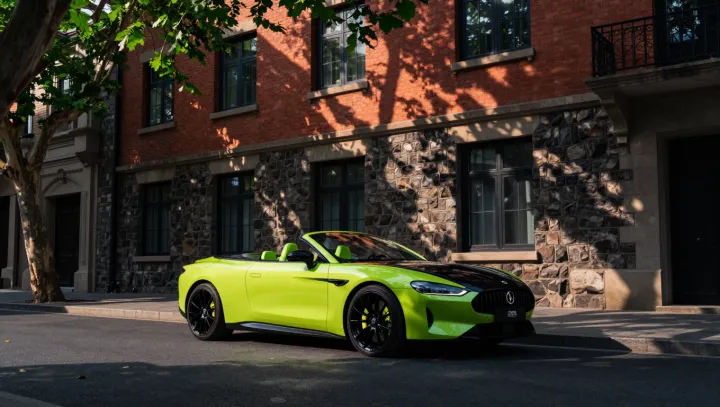
Across a curved fender, green can seem to switch on. It does not. A thin band of specular reflection slides over clearcoat while nearby surfaces fall into shade, making one pigment read as several greens at once; the eye converts that sudden luminance contrast into a verdict of greater saturation.
Geometry does the selling. Automotive panels use changing radii, so their surface normals redirect light toward and away from a viewer as the car moves. Where direct reflection is strongest, highlights may bleach toward a pale green; where diffuse reflection takes over, the same coating appears deeper. Between those states lies the visual payoff: sharp local contrast, which color appearance research associates with a stronger impression of chroma.
Flat panels rarely compete. Metallic flakes and clearcoat add microfacets that scatter and reflect light at slightly different angles, while luminance adaptation keeps the eye recalibrating against the surrounding bodywork. The result feels charged because it never quite settles. No extra electricity lives in the paint; geometry borrows the drama from moving light, then returns it in flashes.