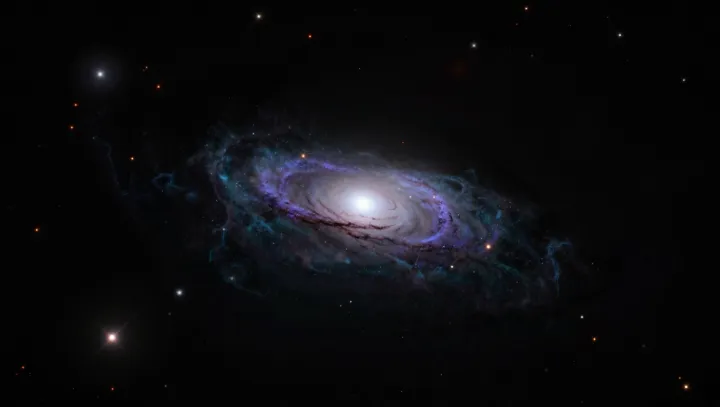
ESO 185-IG013 floods space with visible light despite its compact size. The galaxy concentrates an intense starburst into a small volume, turning a modest mass of gas into a high-output light source.
At the core of this blue compact galaxy, gas collapses rapidly under gravity, driving a spike in the star-formation rate. Astronomers describe this as a starburst phase, when the conversion of cold gas into massive stars becomes highly efficient. These young, hot O- and B-type stars emit strong optical radiation and ionizing ultraviolet photons, which in turn power bright H II regions. Because the stellar mass is crammed into a tight radius, the surface brightness skyrockets, even if the total mass stays lower than that of many spiral galaxies.
The physics is similar to raising the power density of a laser: the underlying mechanism, radiative transfer in dense stellar populations, concentrates energy output per unit area. High gas density, short dynamical timescales and strong feedback from stellar winds and supernovae all help regulate this burst, but while it lasts, the galaxy’s luminosity function is dominated by short-lived massive stars. That imbalance lets a small, blue compact galaxy outshine much larger systems in visible wavelengths.