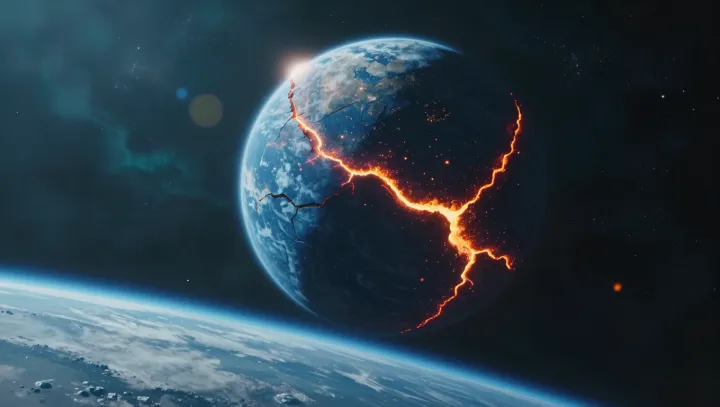
Space, not shrapnel, takes center stage in a growing push to rethink the Big Bang. In this view, the event was not an explosion blasting matter into a waiting void but the instant spacetime itself began to stretch at extreme rates, sending every point racing away from every other without any external backdrop.
Cosmologists trace this picture to general relativity, which treats gravity as curvature of spacetime rather than a force acting inside a static arena. When the equations are run backward, the universe does not converge on a central blast site; instead, the entire fabric contracts toward a hot, dense, high curvature state. Concepts like entropy and cosmic microwave background anisotropy anchor the idea that this early phase behaved as a fluid medium, expanding uniformly rather than throwing off debris.
In that framework, galaxies do not fly through space like fragments from a bomb. Rather, the metric that defines distances between them changes with time, so recession speeds track the scale factor of the universe rather than conventional velocity. The Hubble law, redshift patterns and large scale structure then become signatures of a dynamic geometry, not evidence for an ancient fireball in preexisting space. The familiar image of an explosion gives way to something stranger: a universe in which the stage and the story began in the same act.