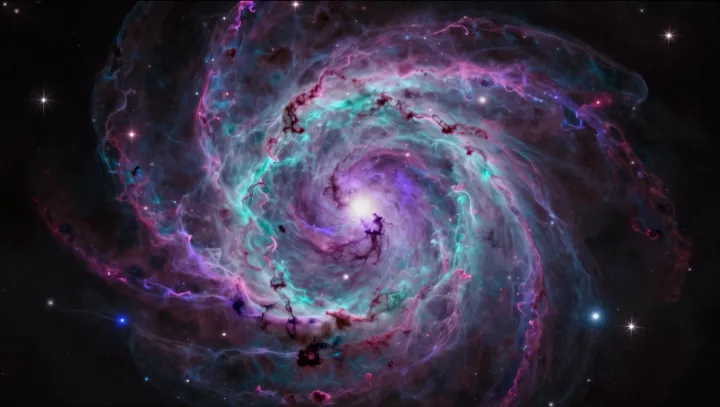
Chaos is overrated here. Bright filaments, dark knots, drifting veils of gas appear unruly, yet every twist inside a nebula traces lines written by Newtonian mechanics and classical gravity. What looks like a random smear of hydrogen and dust is, in practice, a three‑dimensional solution to the same equations that send an apple toward the ground.
The unsettling part is how little the universe improvises. Replace the apple with a proton in interstellar gas and the governing law stays Newton’s law of universal gravitation; add billions of particles and you merely promote the problem to an N‑body system coupled to the Navier–Stokes equations. Gravity sets the large‑scale collapse; pressure gradients and turbulence carve the filaments; radiative transfer cools the gas enough that it can keep falling instead of bouncing apart.
What looks like whim is just resolution. At human scale, we track one apple and call it simple; at nebular scale, we track trillions and call it chaos, yet each parcel of gas accelerates according to F = ma in a gravitational potential well. Magnetic fields thread the clouds and introduce magnetohydrodynamics, but they still do not grant an exception to Newton’s calculus. The same mathematics that times a dropped fruit in a lab quietly choreographs star‑forming clouds across the sky.