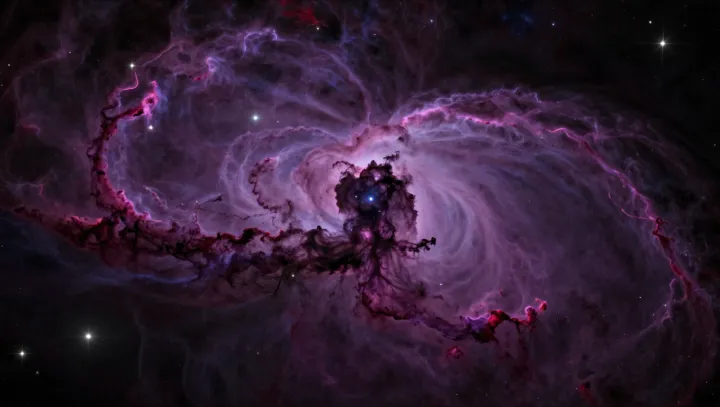
Crowding, not emptiness, defines the most extreme galactic neighborhoods. In dense clusters near a galactic core, stars can sit only light-weeks apart, an arrangement that would dwarf any planetary system and compress it into a tight stellar grid, yet even that apparent congestion hides vast physical gaps between nuclear furnaces that span many billions of kilometers.
The paradox is that galactic collisions look violent while almost nothing solid hits anything else. Stars behave as point masses in a gravitational N-body problem, so during a merger their orbits are simply re-routed by changing gravitational potential, while the actual stellar disks remain unlikely to intersect because each star is tiny compared with the average interstellar separation, which scales to several light-years in more typical regions.
What really collides is gas. Interstellar medium clouds slam together, triggering shock waves, radiative cooling, and bursts of star formation that light up telescopes. Tidal forces stretch spiral arms, bars form, and dark matter halos interpenetrate, yet individual suns pass by unscathed, their planets more at risk from subtle orbital perturbations than from direct stellar impact, so the drama is mostly gravitational, not ballistic.