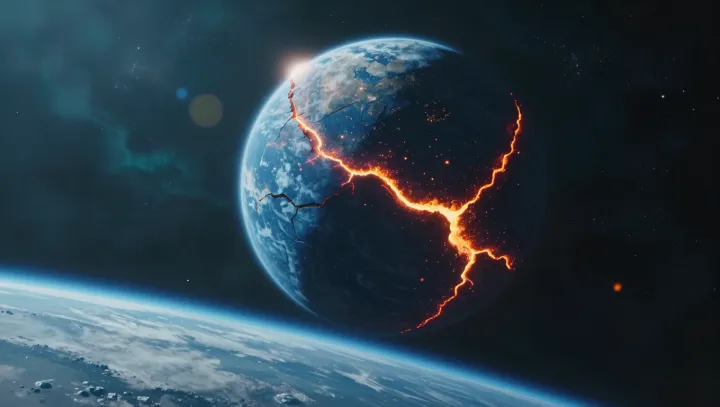
That eerie uniformity across the sky is not comforting; it is a warning flare from fundamental physics. The cosmic microwave background shows nearly identical temperature in every direction, yet standard expansion says far‑separated patches were never in causal contact, never close enough for light or any interaction to even out their conditions.
So something more radical must have happened. Cosmologists argue that a brief phase of exponential expansion, known as cosmic inflation, took a tiny, causally connected region in thermal equilibrium and blew it up to scales larger than the observable universe, stretching once‑neighboring points far beyond each other’s horizons while preserving their near‑identical temperature and density.
This is not just narrative flair; it is encoded in the power spectrum of the microwave background and in the near‑flat spatial geometry implied by general relativity. Quantum fluctuations in the inflaton field, once microscopic, were magnified into the primordial density perturbations that later seeded galaxies, riding on top of an almost perfectly smoothed cosmic backdrop.
Skeptics are right to note that inflation is still a model, not a laboratory‑tested mechanism, with open questions about the inflaton’s identity and the exact potential driving that expansion. Yet without some inflation‑like burst that reshapes the causal horizon, the uniform sky stops looking serene and starts looking like a paradox with no honest exit.