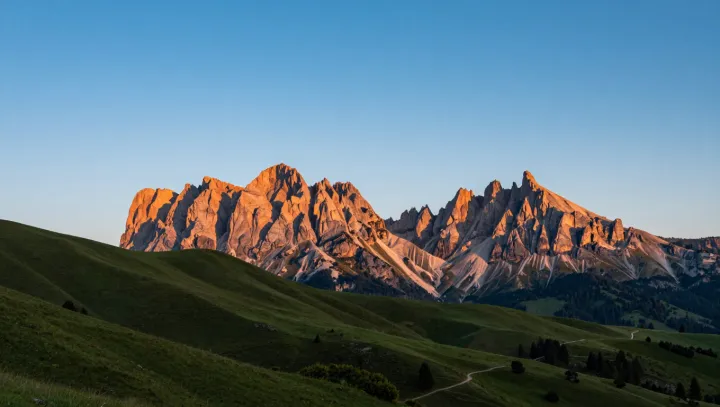
Names on a map sound fussy, but mountain labels are anything but cosmetic. A peak is a point. Sharp, isolated, top of the local relief, it usually marks a summit where erosional processes have carved a single high node out of a broader structure. Cartographers and geomorphologists use the term to signal prominence and a discrete summit area, measurable through topographic prominence and contour spacing.
More structural is the ridge, a word that quietly announces direction and continuity. A ridge is an elongated crest, often aligned with compressional stress in an orogenic belt, tracking the strike of folded strata or the axis of a former anticline. Snow cornices, knife‑edge aretes and serrated spines all fall under this linear geometry, guiding wind flow, drainage divides and even glacier motion along the high line.
Most underestimated is the massif, which is less a summit than a tectonic block. In structural geology it signals a coherent chunk of crust bounded by faults, uplifted as a unit during orogeny and only later sculpted by weathering and glaciation. A massif can contain many peaks and ridges, yet the name insists on rigidity, on shared lithology and joint kinematics. Read the label, and the mountain system starts to explain itself.