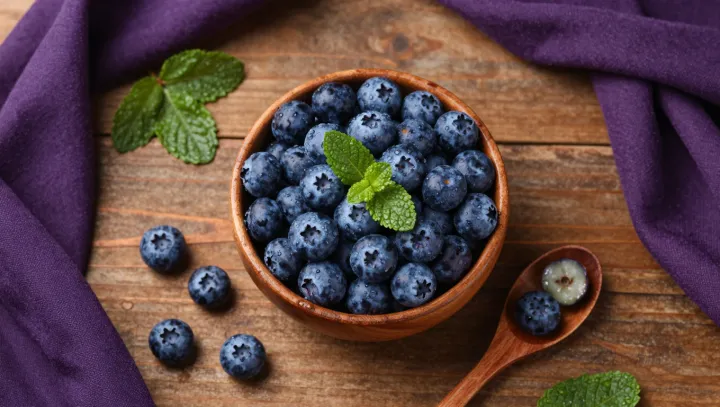
Blueberries look honest. Their smooth, polished skin suggests less risk than a frilled leaf of lettuce, yet the science points the other way. Each berry is coated in a natural wax layer, the cuticle, that behaves like a sticky, hydrophobic film where lipophilic pesticide molecules can lodge and resist casual handling.
That glossy bloom is not just charm. It traps fine soil particles, fungal spores and bacterial cells that arrive in irrigation water or dust, and these particles can carry trace heavy metals and persistent organic pollutants. Laboratory surface assays routinely detect multiple pesticide residues on berry samples, even when they appear visually pristine under retail lighting.
Skipping a rinse is therefore a decision, not a neutral act. Friction from running water, combined with simple mechanical agitation, dislodges loosely bound residues and reduces microbial load by orders of magnitude in some tests, without stripping the cuticle itself. Food toxicology guidelines treat this step as a basic risk‑reduction measure, because ingestion exposure is modeled on what survives only minimal washing at home.
The paradox is plain: the smoother the fruit looks, the easier it is to trust, and the harder it becomes to remember that chemistry, not appearance, governs what still clings to the skin.