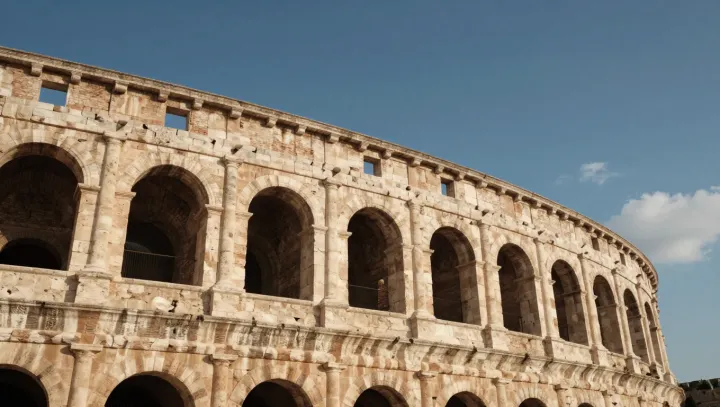
No modern stadium is as bluntly honest about risk as the Colosseum. Its stacked rings, radial corridors and numbered arches form what engineers now read as a full-scale manual on moving tens of thousands of bodies without panic. Short corridors empty fast. Long, looping galleries smooth flow and avoid pressure spikes that cause crush injuries in dense crowds.
More provocative still is how failure made it better science. Where outer walls collapsed, researchers could trace load paths through the barrel vaults and annular rings, mapping compressive stress the way a doctor reads an angiogram. That exposed an early use of structural redundancy: if one arch or pier failed, adjacent masonry picked up load, a principle echoed in modern finite element analysis and performance-based design codes.
Its most unexpected role is as an earthquake textbook. The alternating concrete and stone, the continuous ring foundations, the web of intersecting vaults: together they act like a primitive base isolation and energy dissipation system, lengthening the effective period of vibration and shedding seismic energy through controlled cracking. Where modern labs use shake tables, engineers here walk a scarred arena that has already survived the test.