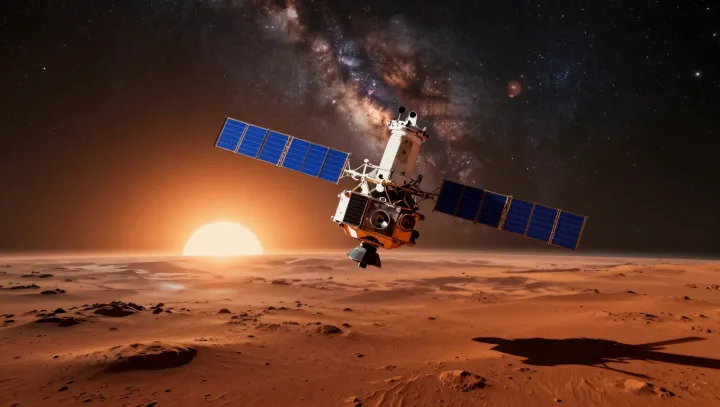
Mars’ shadow sounds like a full stop for a light‑driven craft. It is not. A solar sail builds up orbital energy over many orbits, using tiny but continuous photon pressure when it is sunlit, so a short blackout barely dents its long arithmetic of thrust.
Control, not thrust, is the real concern. Yet attitude dynamics do not switch off in the dark. The sail’s orientation, set by reaction wheels and control moment gyros, keeps evolving according to conservation of angular momentum, while stored commands in guidance software keep the mirror banked at the right angle to resume efficient thrust as soon as the craft exits eclipse and photon flux returns.
Steering can stay precise. Solar radiation pressure is just one term in the equation of motion; Mars’ gravity and the spacecraft’s existing velocity vector keep shaping the path during shadow, and mission designers exploit orbital mechanics and low‑thrust trajectory design so that missing a slice of light is already priced into the route.
Power, skeptics argue, is the real bottleneck. Yet modern arrays and batteries charge during the bright arc, then feed avionics, star trackers, and attitude actuators through the dark, so the guidance, navigation and control loop keeps running while the sail briefly glides on stored momentum rather than fresh photons.