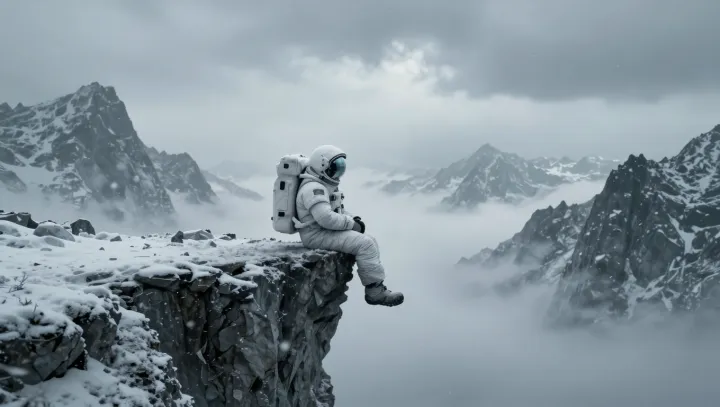
Blinding whiteout turns the world into a lie. On an icy ledge, motion feels like control, yet survival instructors in astronaut programs argue the opposite: stillness is often the only rational move. In that featureless glare, the vestibular system misfires and the brain loses any reliable sense of vertical or depth.
The harsh truth is that physics does not care about panic. A single step on a low-friction surface shifts the center of mass beyond the base of support, and with no visual horizon to anchor balance, the fall risk skyrockets. Short bursts of movement. Tiny muscle twitches. Each one can propagate into an uncontrolled slide that no crampon or gloved hand can stop.
Energy, too, becomes an unseen enemy. Rapid motion burns oxygen and accelerates carbon dioxide buildup inside a suit, stressing cardiovascular and respiratory systems already near their limits. By locking down, minimizing joint motion, and using deliberate isometric tension, astronauts buy time for rescue teams, for weather to clear, or for instruments like inertial measurement units to regain primacy over gut feeling. Stillness, in that blinding field of white, is less about courage than about refusing the brain’s most dangerous illusion: the belief that any move is better than none.