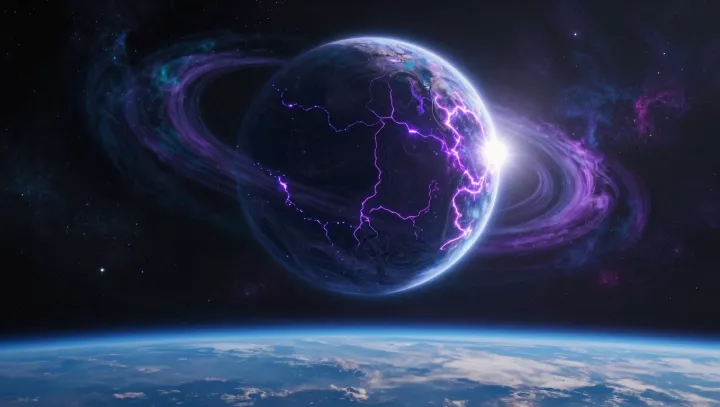
A broken planet could be more stable than it looks. Those glowing fractures would not mark a firework about to go off, but a body still locked together by gravity and pressure while its skin fails in slow motion.
The key is brutal but incomplete tidal forcing. A close orbit around a dense object can pump energy through differential gravity, driving tidal heating and shear that exceed rock strength yet never quite overcome total gravitational binding energy. Crustal plates would wrench apart. Mantle material, kept near its solidus by internal pressure, would flash into partial melt inside deep fissures, radiating in visible and ultraviolet bands once exposed to near vacuum. Volatiles and ionized metals in that vented gas could scatter light into eerie purples, much as auroral emission lines color a magnetosphere.
Even the color can be engineered by physics, not fantasy. Strong magnetic flux from the parent object could funnel charged particles straight into the cracks, turning them into elongated auroral arcs while Joule heating keeps magma incandescent. High‑pressure mineral phases would still buttress the interior, behaving like a compressed spring lattice that absorbs shock instead of shattering outright. The result is a planet that looks like fractured glass yet remains, for a while, a single, unwilling world.