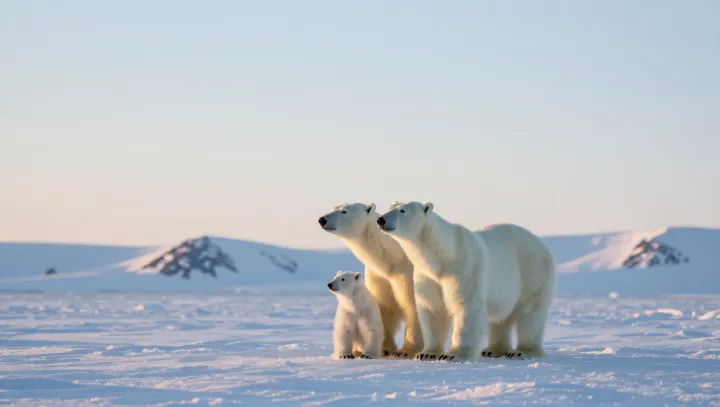
Bare ice should be a death sentence for a newborn polar bear, yet a mother’s body functions as moving infrastructure. Around each cub she builds a living wall of blubber and fur, creating a steep temperature gradient between the air and her skin while keeping her core temperature within a narrow safe range.
The real surprise is how little magic and how much physics are involved. Her subcutaneous fat layer, far thicker than in most mammals, slashes thermal conductivity, while hollow guard hairs trap air and act as a multi‑layer insulator against convective heat loss. Pressed against her abdomen, the cub lies in contact with a zone of high peripheral blood flow, so conductive heat transfer is rapid even though the outside environment remains far below freezing.
What looks like simple cuddling is in fact active thermal management. By curling her body into a tight arc, she minimizes exposed surface area and creates a pocket that blocks wind, reducing convective and evaporative cooling on the cub’s damp fur. Brown adipose tissue and a sharply elevated basal metabolic rate supply the heat budget, while vasoconstriction in her outer limbs limits unnecessary loss, so more of that metabolic energy is leveraged into the microclimate around her offspring.
The stark truth is that the cub contributes almost nothing to its own survival at this stage. Its thin skin, minimal fat reserves, and immature thermoregulatory system would fail within minutes without that maternal heat shield. By turning her body into a portable den, the mother buys time for the cub’s fur density, fat stores, and hypothalamic control to mature enough that the ice stops being instantly lethal and becomes merely hostile.