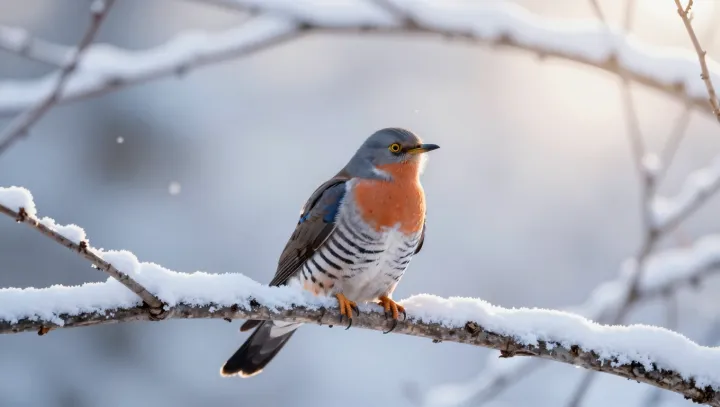
Snow on its back looks like a death sentence for a cuckoo, yet that still body is making a hard calculation. Thin bones and slight muscles are not a flaw here but a way to slash energy demand when food vanishes, turning apparent weakness into a strict survival budget.
Key is energy economics. A light frame needs less fuel for basic cellular respiration, and a small digestive system wastes little heat on processing bulky prey, so the bird can ride out long fasting windows when insects hide or die. Instead of fleeing, it cuts costs. Hard. Under the feathers, dense plumage traps air like aerogel, while subcutaneous fat forms a compact thermal buffer; together they shrink the temperature gradient between skin and air, easing the work of thermoregulation and protecting core organs from lethal cooling.
This bird also plays time. Some individuals enter shallow torpor, dropping body temperature and heart rate just enough to shave the metabolic rate without risking ice in tissues, a narrow physiological corridor that demands precise endocrine control. Roost choice adds another layer of engineering: deep conifer cover, south facing ledges, and cavities that harvest reflected radiation can raise local microclimate several degrees, effectively outsourcing part of the heating bill to the landscape. So the cuckoo stays, not because it is strong, but because it is frugal in ways migrants cannot afford.