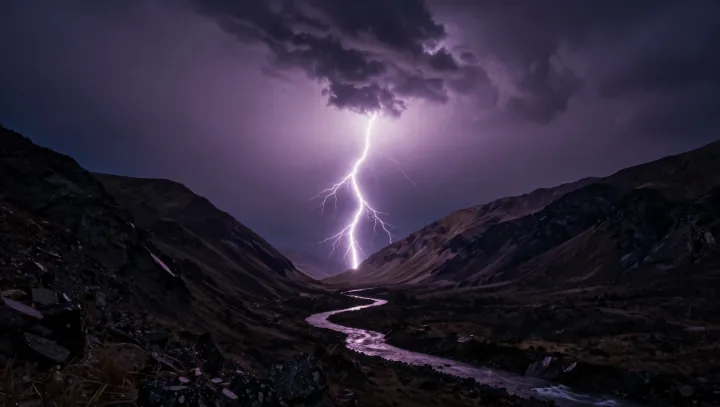
Lightning is not violet at all. The discharge is close to white, a broad spectrum blast shaped by plasma at extreme temperature and ionized air radiating across many wavelengths in a fraction of a second.
The strange part sits in the eye, not the cloud. Human color vision shifts under such brief, intense flashes because cone cells saturate while rod cells, more sensitive in low light, keep feeding the brain a skewed signal, a phenomenon tied to the Purkinje effect and temporal integration in the retina. In that instant, the visual system overemphasizes shorter wavelengths, so any scattered blue and violet light gets disproportionate weight compared with red that rods handle poorly.
The air finishes the trick. Molecules in the storm sky favor shorter wavelengths through Rayleigh scattering and Mie scattering, kicking blue and near violet sideways into your field of view while longer wavelengths pass or are absorbed by cloud and rain. Dark clouds and wet ground absorb much of the red and yellow component of the flash but reflect the cooler end of the spectrum more efficiently, so the entire scene echoes that bias. The bolt stays almost white, yet the world around it, filtered by air and edited by the eye, flares briefly in violet.