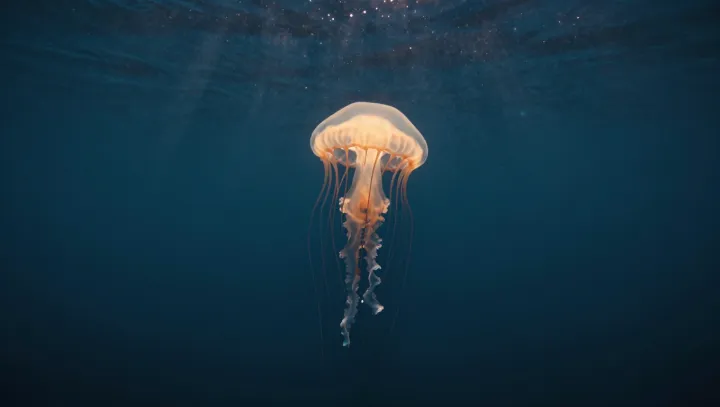
Transparency is not a handicap here; it is stealth. A gelatinous body lets prey drift closer, while the real action happens inside microscopic capsules called nematocysts, each packed with a coiled tubule under extreme osmotic pressure. Light is irrelevant. What matters is contact: hair‑like mechanoreceptors and chemoreceptors on the surface register a passing crustacean or larval fish, triggering discharge in less than a thousandth of a second.
The real surprise is not the sting, but its accuracy. Instead of a single brain‑driven shot, evolution has scattered a mesh of short neural circuits along the tentacles, creating local decision units that fire only when mechanical force and chemical cues align. That conditional logic, encoded in ion channels and synapses, stops the animal from wasting expensive nematocysts on drifting detritus, and concentrates volleys where prey density is highest.
Power, in this ghostlike hunter, comes from scale and statistics, not eyesight. Thousands of cnidocytes, each a disposable micro‑syringe loaded with neurotoxin peptides, fire in overlapping patterns that effectively paralyze prey even in complete darkness. The body may vanish into the water column, but the physics of fluid flow, surface sensors, and high‑pressure discharge give its invisible outline a very sharp edge.