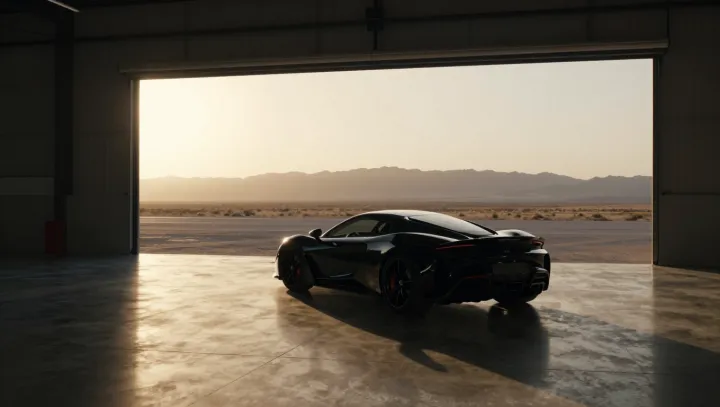
Emptiness is the problem, not the speed. On a bare desert runway, drivers lose motion cues long before the car runs out of power, so engineers have to make the machine feel stable even when the human brain is half blind.
Stability starts with air, not courage. The body is shaped as a low wing, generating hundreds of kilograms of downforce through the rear diffuser, front splitter and underbody Venturi channels, so at 300 km/h the tires see far higher normal load and the contact patches stay locked instead of skating across micro ripples. Tiny tweaks in rear wing angle or rake change the aerodynamic center of pressure by millimeters, but those millimeters decide whether the car tracks straight or begins a slow, lethal drift.
Electronics then clean up what physics leaves messy. A high speed yaw rate sensor, wheel speed sensors and an inertial measurement unit feed an electronic stability control unit that trims torque and brake pressure on individual wheels in a few milliseconds, creating invisible micro corrections the driver could never apply by hand. The steering rack is given a very tight on center dead band and carefully tuned self aligning torque, so around straight ahead the wheel feels like it rests in a shallow groove, giving the driver an artificial sense of straightness even when the horizon offers no reference.
The runway itself must carry part of the load. Longitudinal paint markings, contrasting edge lines and evenly spaced cones or light pylons are laid out not for the camera, but to restore optic flow, so the driver can judge speed and lateral deviation without guessing. Wind is monitored and runs are scheduled within narrow crosswind limits, because a small gust angle at 300 km/h multiplies into a strong lateral force on the large side area, and no amount of software can fully cancel a bad air mass.