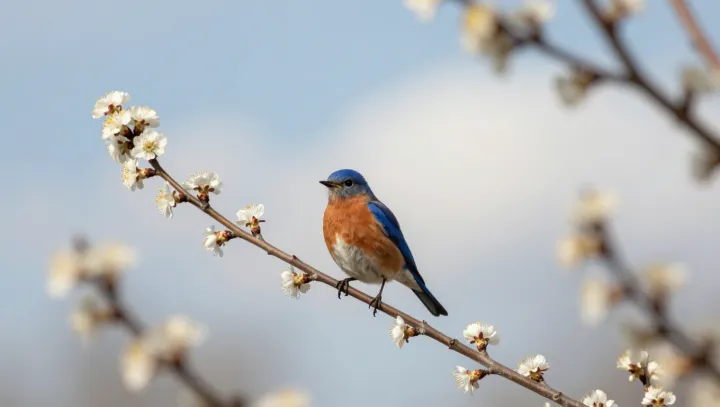
Blue on a bird is an optical trick, not a paint job. Where pigments fail, structure takes over, as feathers assemble transparent material into nanoscopic mazes that grab incoming light and send back only a tight slice of the spectrum we read as blue.
The odd part is that this showy signal doubles as camouflage. By tuning keratin and air into quasi-ordered photonic crystals and exploiting Rayleigh scattering, feathers push most wavelengths sideways or inward, while reflecting blue in a diffuse, almost cloudy way that echoes the hazy light across spring blossoms and sky. Petals, young leaves and ambient air share similar scattering regimes, so the bird’s plumage does not sit on top of the scene as pigment would; it melts into the same optical background noise.
What looks like a solid hue is, under a microscope, a statistical pattern. Slight disorder in the nanostructure broadens the reflected band, softening edges and preventing hard outlines that predators track. That same physics lets tiny posture shifts modulate brightness without changing the underlying anatomy, a kind of dynamic, low-energy display system baked into keratin. In that narrow gap between signal and concealment, the bright blue bird survives.