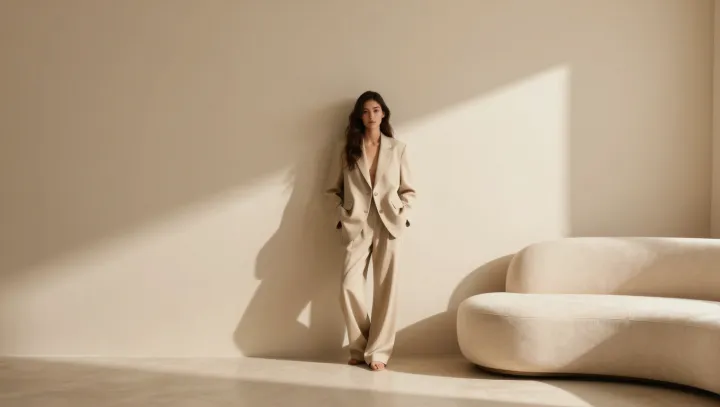
Beige stopped trying to impress the room and started controlling it. Once a default summer option, the pale suit has been re-engineered by stylists and image consultants as a precision tool, using low-value contrast to pull attention upward toward the face, not the fabric, in settings where scrutiny is intense and time is limited.
The real trick is counterintuitive: softer cloth makes harder features. By muting chroma and narrowing the luminance gap between jacket, shirt and skin, beige creates a kind of visual noise-cancellation that amplifies bone structure, eye whites and micro-expressions. Colorimetry and facial perception research both show that when contrast drops below the usual dark-suit baseline, observers unconsciously scan eyes and mouth more closely, reading confidence and control faster.
Power, here, is less about dominance than about bandwidth management. Dark navy broadcasts the suit; beige edits it out, freeing cognitive load for what is being said. That restraint pairs neatly with slim notch lapels, soft shoulders and almost invisible shirt stripes, a quiet uniform that telegraphs self-possession in rooms crowded with louder signals. Beige, worn with intention, has become the suit version of a whisper that everyone leans in to hear.