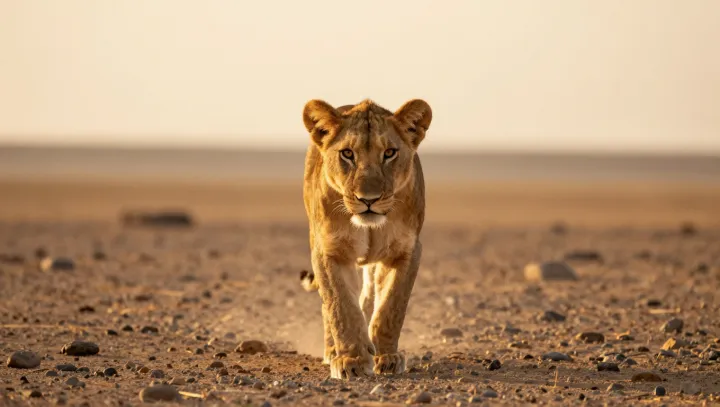
That wobbling cub is not failing at walking; it is rehearsing survival economics in real time. Each hesitant step, though scattered and uneven, already mirrors the cost–benefit rules that govern adult hunters across open grassland.
At the core is energy conservation. Predators lose more hunts than they win, so every stride is a budget line. By moving slowly, with long pauses, the cub keeps heart rate low and limits adenosine triphosphate turnover in skeletal muscle, protecting scarce glycogen reserves that will later fund explosive chases. Short. That lazy-seeming amble trains slow‑twitch muscle fibres and joint proprioception while avoiding the oxidative stress that constant sprinting would trigger in a growing body.
Even more counterintuitive, clumsiness doubles as a scanning protocol. That stop‑start gait forces frequent head lifts and micro‑halts, widening visual and auditory sampling of the savanna. Peripheral vision checks brush; whiskers test wind; ears triangulate rustles. Short again. The cub learns to separate background noise from the faint cues of prey or rival predators, building the threat‑detection circuits adults depend on when one misread shadow can mean a failed hunt or a fatal ambush.
So the slow walk stays. Long after the awkwardness fades, adult lions still rely on that same low‑gear patrol: quiet, metabolically cheap, and constantly reading a dangerous horizon.