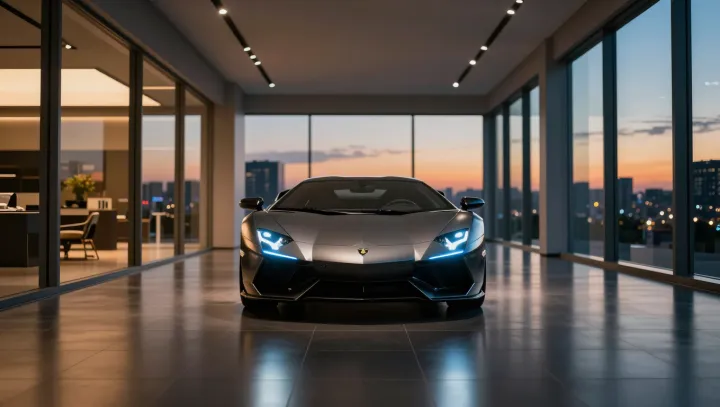
Dusk lighting makes a parked supercar look faster than its own lap. That is not an illusion of marketing alone; it is a quiet collision between physics, optics and human perception. Under controlled showroom light, specular highlights trace every crease of the bodywork, and those reflections move more than the car does, sliding along carbon fiber like bright contour lines on a topographic map of speed.
Design does the rest. Supercar surfacing is tuned for both aerodynamics and static drama; the same channels that manage boundary layer flow and reduce pressure drag are sculpted to cast hard shadows and razor reflections at rest. On track, real motion blurs those cues. Human visual acuity drops once objects sweep across the retina; at high angular velocity, your eyes stop reading panel tension and start tracking only a colored shape and a streak of exhaust heat.
Showrooms quietly cheat the race. Low, raking beams exaggerate curvature, high contrast hides awkward radii, and stillness lets your brain run its own wind tunnel simulation, filling in downforce and velocity that are not yet there. At speed, cameras and spectators stand far away, compressing perspective and flattening stance, while tire deformation, pitch and roll are too fast or too distant to decode, so the car looks simpler, calmer, almost slower than the fantasy you built under that soft, fading light.