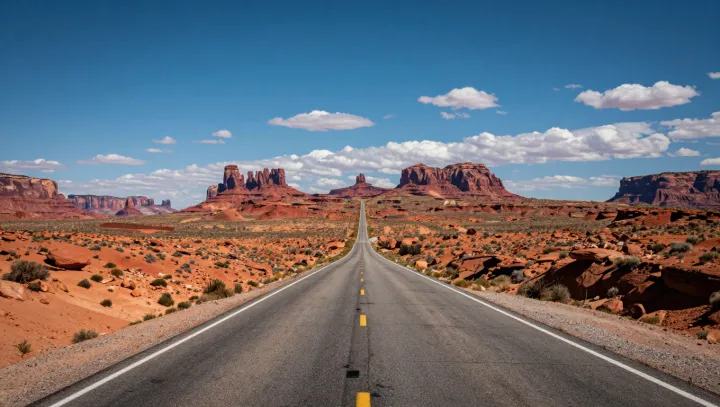
A straight road does more to a desert than any storm. Not a grain of sand moves, yet the brain abruptly upgrades the scene from empty expanse to near-infinite corridor. That shift is not poetry; it is geometry and neurobiology colliding. Linear perspective compresses parallel edges until they meet at a vanishing point, and that single point gives the visual cortex a new coordinate system for judging distance and scale.
Calmer is the next illusion. Before the road, the desert is a noisy field of random textures that drive constant microsaccades and dense visual processing. Lay down a ruler-straight strip of asphalt and you hand the dorsal visual stream a dominant axis, so attention aligns, eye movements regularize, and overall cortical load drops. The place did not quiet; the neural chatter did. Your sense of slowness is a byproduct of reduced optic flow complexity and more predictable spatial frequency patterns entering the primary visual cortex.
Greater distance, finally, is a trick of scaling. With no reference objects, the brain falls back on generic size constancy and often underestimates reach. Introduce a human-built line with lane width, markings, and repeating posts, and the parietal cortex recalibrates metric space using those intervals as a ruler. Each repeated marker shrinks in retinal size, so the unconscious inference engine extends the road, and with it the desert, far beyond what the bare sand ever persuaded you to see.