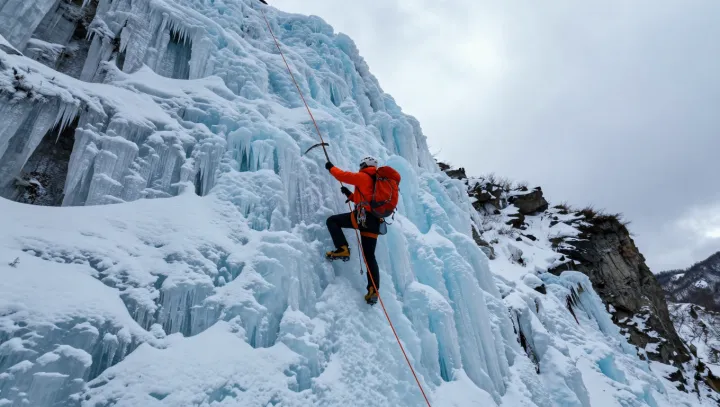
A vertical sheet of blue ice looks like a freezer door, yet it becomes a furnace for the body that attacks it. The paradox is simple. The wall steals heat; the climb spends fuel fast enough to replace it.
Ice climbers survive not through toughness but through physics and physiology working in tandem. Layered clothing traps still air, a low-tech but effective thermal barrier that limits conductive and convective heat loss into the ice and wind, while vapor-wicking fabrics slow evaporative cooling from sweat that would otherwise chill skin in minutes. Around this, a shell blocks wind, cutting the brutal heat drain of forced convection across exposed surfaces. The result is a narrow thermal margin, not comfort.
The dramatic weight loss comes from the same system running near redline. Continuous swinging of tools, high-tension footwork on crampons, and isometric contractions in the core drive oxygen consumption and spike basal metabolic rate several times above rest. Add cold-induced thermogenesis, where brown adipose tissue and skeletal muscle burn extra substrate simply to maintain core temperature, and total energy expenditure can rival that of elite endurance events. Glycogen stores deplete, fat oxidation surges, and water is lost through respiration and sweat that never feels like sweat because it flashes away in dry air.
The hard truth is that safety hangs on a balance sheet of heat and calories. Too little insulation, and convective and conductive losses win. Too little food and fluid, and the metabolic furnace falters, stripping mass but also blunting shivering and neuromuscular control just when an ice screw must be placed cleanly. On a hanging belay, the climber is not just fighting gravity. The climber is racing thermodynamics.