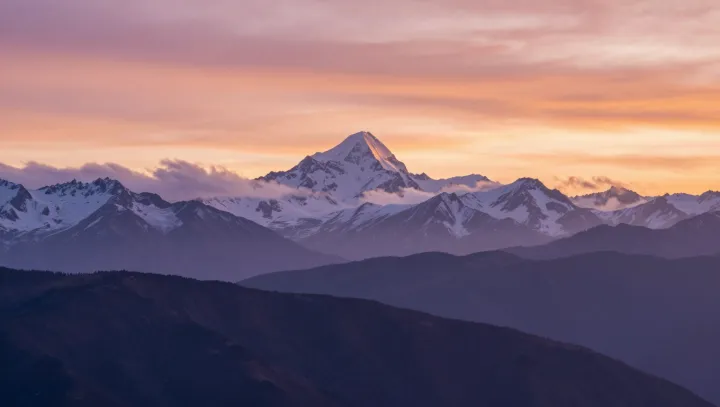
Snowy ridges, not famous spires, usually win the sunset contest. Thin air strips out much of the short-wavelength blue through Rayleigh scattering, so what survives toward the horizon is a surplus of reds and oranges that bounce off high-albedo snow, boosting luminance and color contrast far more than bare rock can.
More dramatic still is the depth trick your eyes fall for. A chain of staggered ridgelines acts like a natural tomographic stack, each layer sitting behind a slightly thicker slice of aerosol and water vapor. That extra optical depth raises atmospheric extinction and aerial perspective, so each ridge shifts a bit duller and redder, sharpening relative depth cues far beyond what a lone peak can offer.
The surprise is that softness beats sharpness. Wide snowfields provide broad, uniform reflectance that lets your visual cortex compare subtle gradients of hue and brightness across the entire field, engaging contrast sensitivity and edge detection more intensely than a single jagged summit. Under low solar elevation, when long-wavelength light skims through the most atmosphere, those quiet white slopes turn into exaggerated contour lines of the sky itself.