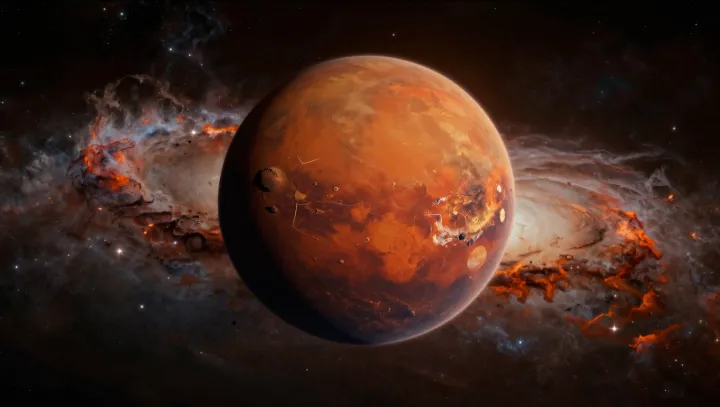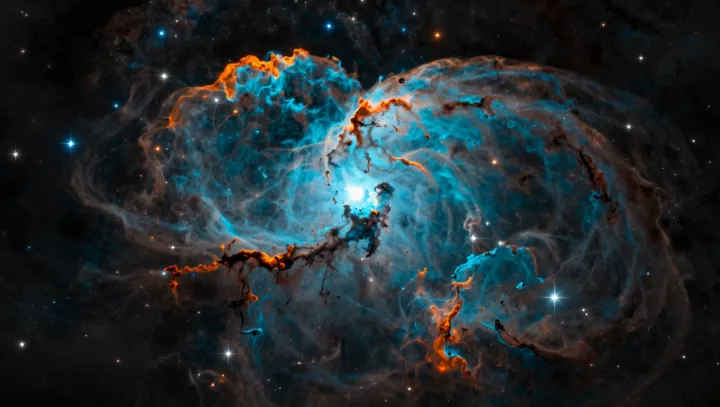
Those pale blue and orange clouds are not gentle at all. They are factories. A typical nebula holds millions of solar masses of gas and dust, spread thin, with densities far below human vacuum chambers, yet spread over light-years of volume, the total mass is enormous.
The real trick is gravity acting with obscene patience. Tiny overdensities form inside a cold molecular cloud; turbulence and magnetic fields shuffle material, and regions that cross the Jeans instability threshold start to collapse. One patch contracts, cools by radiative emission, then contracts more, because lower thermal pressure can no longer resist the self-gravity pulling every atom inward.
Star birth is therefore less explosion, more slow avalanche. As each collapsing core spins up, conservation of angular momentum flattens infalling gas into a protoplanetary disk around the young protostar. In that disk, dust grains collide, stick through van der Waals forces, grow into planetesimals and then into planets, while leftover gas feeds both the star and any emerging giant worlds.
What looks like empty color on a telescope image is structured chaos. Shock fronts from earlier stars, ionization fronts carved by stellar radiation, and large-scale supersonic flows keep sculpting the cloud, seeding new overdensities that repeat the cycle and pack hundreds of stars into what the eye mistakes for almost nothing.