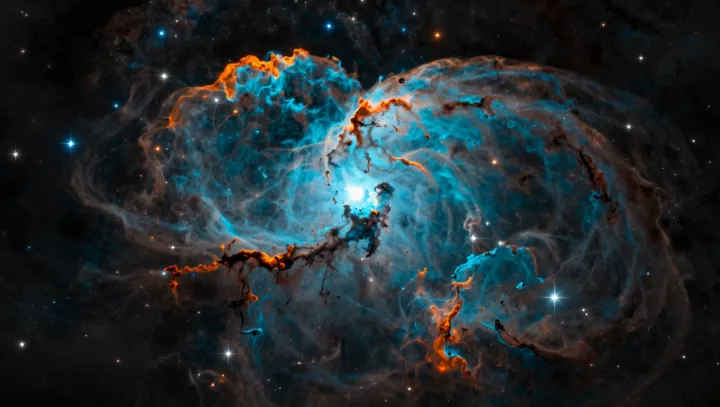
A ring seen edge-on should vanish. Instead, against a bright nebula, it can flare into a sharp luminous line that humiliates both the planet’s horizon and the field of stars.
The surprise is not brightness. The surprise is direction. Tiny icy grains act as brutally efficient forward scatterers, a process described by Mie scattering and phase function peaking, so they redirect nebular light almost straight along the incoming path toward the observer. The nebula radiates over a wide solid angle, its glow smeared and diluted, while the ring behaves like a narrow optical waveguide that concentrates that same light into a thin angular slice.
Equally counterintuitive is the way fragility becomes power. The ring’s apparent thinness hides an enormous column density; along the edge-on line of sight, the path length through the ring plane multiplies the number of scattering centers, boosting optical depth without turning the structure opaque. High albedo water ice, near-Lambertian for many angles yet heavily biased forward, means each grain wastes little incoming flux. The planet’s horizon, by contrast, is mostly absorbing rock and cloud, with limb darkening and atmospheric extinction muting reflected intensity, and background stars are point sources easily drowned once the ring’s integrated scattered light crosses a modest threshold.
So the eye is tricked. A structure that looks like a hairline cut in space becomes, under the right geometry, the most efficient light redirector in the scene.