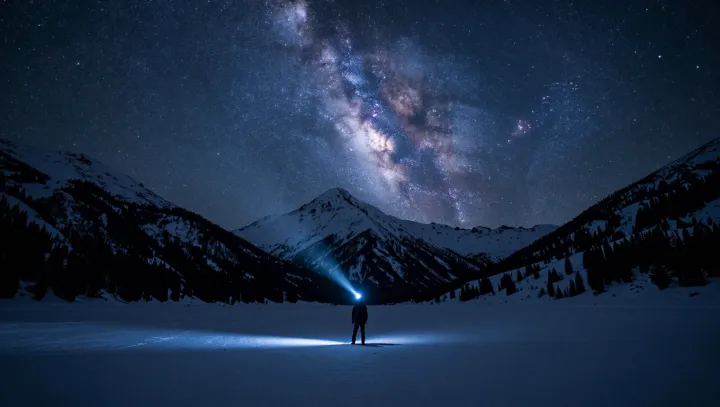
Night air over Mount Niubei cheats the eye in your favor. Stars are not stronger there, yet they punch harder into your vision because the medium between you and them changes, not the stars themselves.
The blunt truth is that cities wreck starlight. Thick, low-altitude air adds more molecules for Rayleigh scattering, plus aerosols and dust for Mie scattering, so incoming photons are bounced, smeared and partly absorbed before they reach your retina. On a high ridge, the air column above you is shorter, air density drops, and humidity often falls, which together reduce refractive index fluctuations that drive astronomical seeing, the technical term for the twinkling blur that softens stellar points.
Light pollution then finishes the job in urban streets. Skyglow from street lamps and billboards lifts the background luminance so your rods and cones operate in mesopic vision instead of true scotopic vision, killing sensitivity to faint contrast. At Mount Niubei, the darker sky lowers that background, so the same stellar flux stands out with a higher signal-to-noise ratio. Add less atmospheric extinction at altitude and each star’s point spread function tightens. They are the same distant suns, but the optical system between them and you becomes cleaner, colder, almost surgical, and the night feels newly carved out of space.