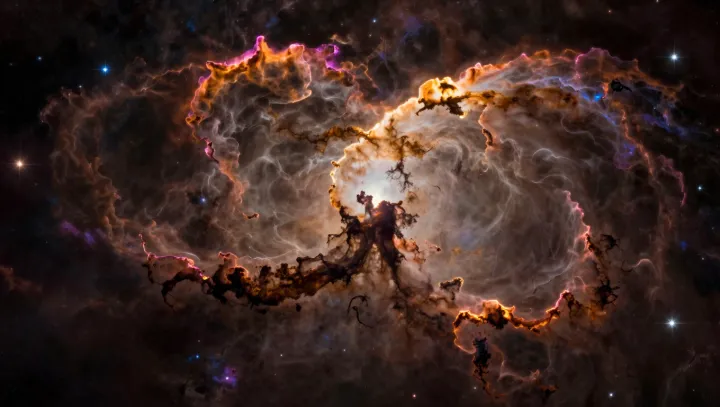
An empty-looking patch of sky is often lying. Against the glare of visible light, cold molecular gas and dust sit almost invisible, because their grains scatter and absorb short wavelengths while re-radiating energy at far longer ones that human eyes cannot detect.
The real surprise is how much mass fits into that darkness. Radio maps of carbon monoxide emission, a standard tracer for molecular hydrogen, reveal giant molecular clouds that stretch across dozens of light years, with total masses comparable to millions of suns, even when visible images show only a faint smudge or nothing at all.
Star factories prefer to work in the shadows. At temperatures only a few degrees above absolute zero, gas pressure stays low, so gravity can overcome thermal motion and trigger gravitational collapse inside dense cores, a process described by the Jeans instability, turning hidden clumps into protostars behind an apparently blank curtain.
The real giveaway comes from wavelengths that ignore dust. Infrared detectors and millimeter interferometers record thermal emission from dust grains and rotational lines from molecules, converting faint flux into column density and mass estimates that add up quickly, enough to seed clusters containing thousands of new stars.