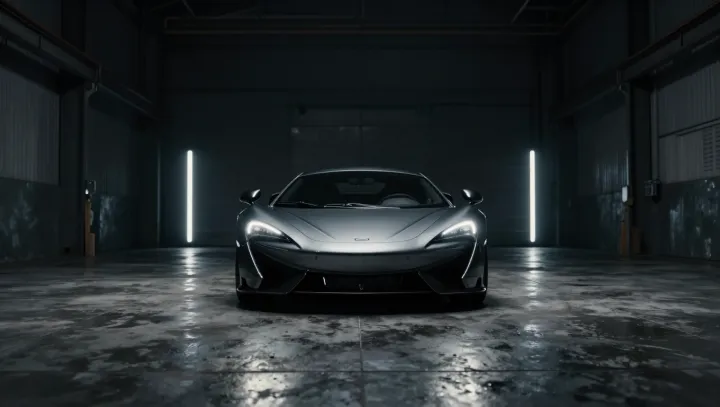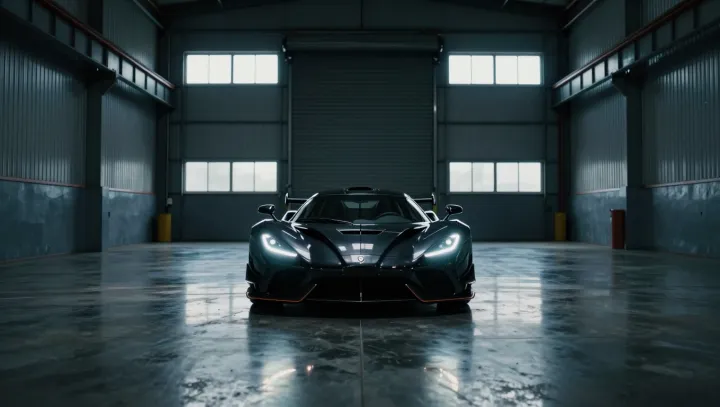
Silence wins here. The glossy workshop floor holds a low black supercar under sparse industrial light, while its LED headlights carve out a narrow corridor of visibility that feels more like intent than illumination, turning the dim garage into a kind of wind tunnel set-piece without the noise of fans or data streams.
This scene argues that performance now markets itself through geometry, not spreadsheets. A wide front splitter juts forward like a thesis statement, managing pressure differentials and feeding a precise airflow regime that any computational fluid dynamics model would recognize long before a casual observer notices the badge, while hood vents sit like pressure valves, bleeding off turbulent air to stabilize the front axle and visually flatten the car against the floor.
Even the closed roller door plays accomplice. By sealing off the outside world it creates a controlled envelope, a visual test cell where ride height, track width, and camber read as design parameters as explicit as drag coefficient or frontal area, and the static stance sells the idea that downforce and mechanical grip are already loaded, waiting, long before the engine ever turns over.