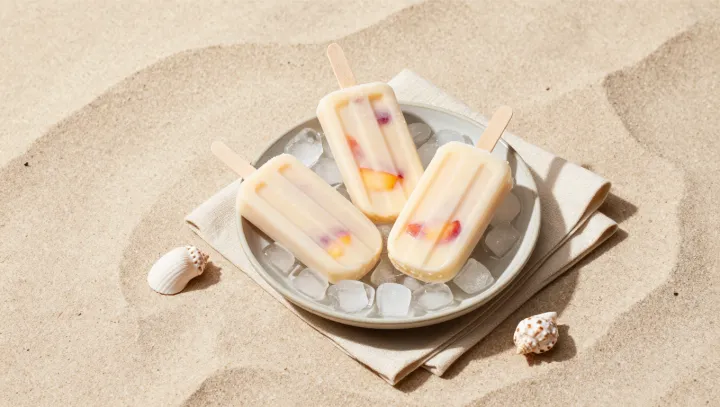
A tray of ice can act less like water and more like a silent flavor editor for tropical popsicles. Cold hits first. Then physics quietly rewrites the recipe as the mixture freezes around those cubes.
The counterintuitive part is simple: flavor does not freeze evenly. Thanks to phase separation and freezing point depression, pure water in and around the cubes solidifies first, while sugars, acids and aromatic compounds in mango, pineapple or passion fruit stay in the still-liquid fraction. That concentrated liquid is what finally locks into the thin channels between cubes and along the mold walls, so every bite taken from the finished pop often carries a slightly higher ratio of dissolved solids than the starting mix.
Texture, not just chemistry, pushes the effect further. As the cubes chill the mix from the inside, they speed up ice crystal nucleation, which can limit large, dull-tasting crystals and create a snappier bite that makes acidity and esters feel brighter on the tongue. Pull the cubes once the shell is firm, refill the cavities with the same tropical base, and a second freeze pass stacks concentrated layers around those first channels. The result is not a weaker drink on a stick but a stratified bar where controlled dilution and directed freezing make the fruit taste louder.