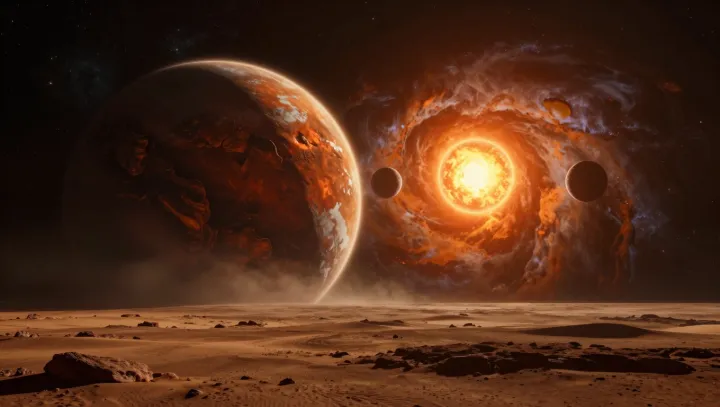
Planet birth, it turns out, looks less like a single grand event and more like a mess. Dust swirls in a protoplanetary disc, clumps, shatters, sticks again. What was once modeled as a smooth, almost bureaucratic process now appears granular, chaotic, and endlessly repetitive.
The new view comes from high-resolution N-body simulations coupled with hydrodynamics, which finally track individual grains, pebbles and planetesimals instead of averaging them into anonymous rings. Researchers follow angular momentum transfer and collisional fragmentation at scales where a meter-size boulder matters, because its fate slightly shifts the odds of a planet ever existing. Each micro-impact either adds to a proto-world or grinds it back toward dust, creating a feedback loop between accretion and erosion that older models simply smeared out.
What these digital junkyards show is blunt. Planets are statistical survivors, not destined outcomes. Many embryos stall, some are cannibalized, others migrate inward and vanish into their star. Only a fraction of the initial solid inventory escapes gas drag, resonances, and destructive impacts long enough to become a stable globe. In that quiet arithmetic of gain and loss, a familiar rocky world is just one improbable sum.