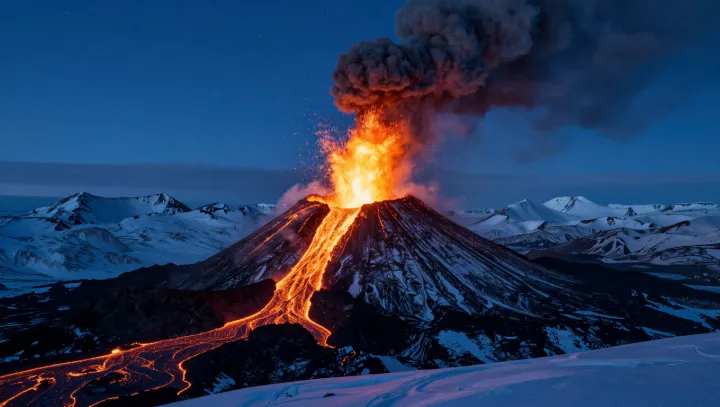
A snow-capped summit is not a contradiction to lava that can liquefy rock; it is a geometry problem. At the core sits magma at temperatures above basalt’s melting point, driving eruptions through narrow conduits that act like pipes in a heating system, not like open bonfires spread across every exposed surface.
Counterintuitively, most of the peak stays cold because heat transfer is brutally local. Conduction through solid rock is slow, convection is concentrated in vents, and radiant heat drops off sharply with distance. Where lava flows or hot gases contact snow, it vaporizes. A few ridges away, the same snowpack sits above permafrost and chilled bedrock, buffered by low air temperatures and wind that strips heat faster than it arrives.
The real surprise is how good snow is at self-defense. Fresh snow has high albedo, reflecting a large fraction of incoming thermal radiation, while its trapped air pockets make it a weak conductor. The result is a rough patchwork: black lava channels and ash scars cutting through bright white islands of ice that survive because physics, not drama, sets the boundaries of the burn.