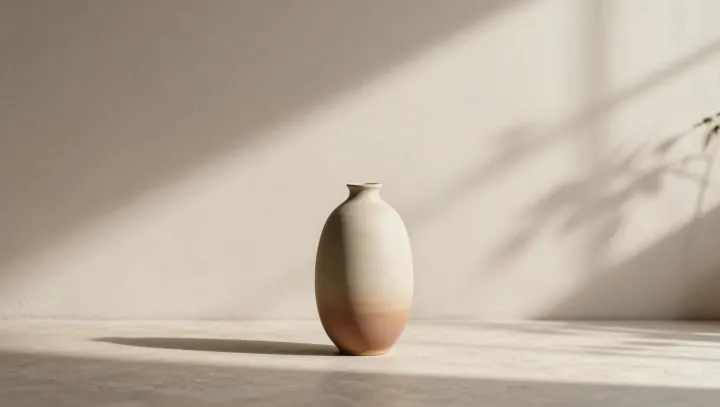
A rough clay vase does more psychological work than an entire wall of white. Its pitted surface introduces what environmental psychologists call low-level visual complexity, tiny deviations that give the eye something to solve without effort. Those micro-variations soften the sharp edge of a room where planes, lines, and colors are otherwise brutally consistent.
The calm, counterintuitively, starts in prediction error. Ultra-minimal rooms feed the visual cortex with almost perfect regularity, so the brain’s predictive coding machinery has little to update and begins to search for anomalies, which can raise arousal. A handmade vessel, with asymmetry and visible tool marks, creates gentle, non-threatening irregularity. That kind of stochastic patterning has been linked in studies on biophilic design and fractal geometry to lower heart rate and reduced electrodermal activity.
There is also a social charge in that lump of earth. A thrown clay form carries evidence of haptic feedback, of fingers correcting collapse. Neuroimaging work on mirror neurons suggests that viewers simulate such gestures, gaining a faint bodily echo of another person’s effort. In a space where light, layout, and color barely shift, that single trace of human labor can be enough to tip the room from abstract display toward shelter.