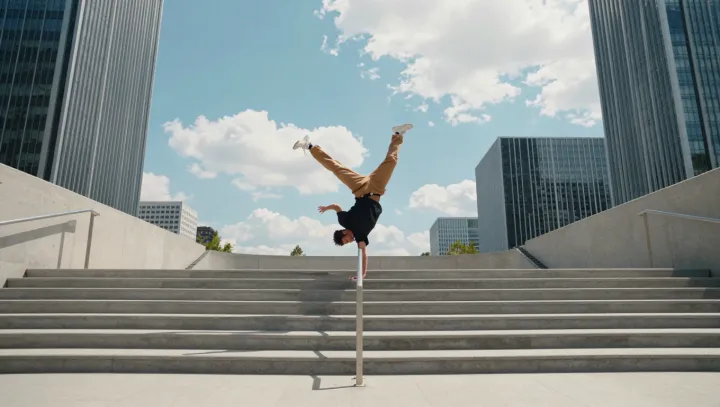
Concrete steps, not foam blocks, push balance training into honest territory. A one-arm handstand on a narrow edge exposes every error in center-of-mass control and ground reaction force, because the surface does not compress, forgive, or mute feedback from the wrist and shoulder.
Hard stair edges turn the arm into an engineering report. Under load, the wrist experiences clear shear and compressive forces, while the glenohumeral joint and scapulothoracic complex manage torque that padded floors spread and blur. That sharp interface magnifies tiny changes in moment arm, forcing the athlete to refine scapular upward rotation and rotator cuff co-contraction with far more precision than a soft mat demands.
The real surprise is neuromuscular. On city steps, proprioceptors in the fingers and wrist send cleaner, faster signals than they do through layers of rubber, which dampen vibration and delay correction. Micro-movements in the lumbo-pelvic complex, deep spinal stabilizers, and finger flexors become binary: either they fire in tight closed-loop control, or the body slides off the step. Noise from music, traffic, and foot traffic only adds to the test, forcing selective attention and sensorimotor filtering that many controlled gyms never simulate.