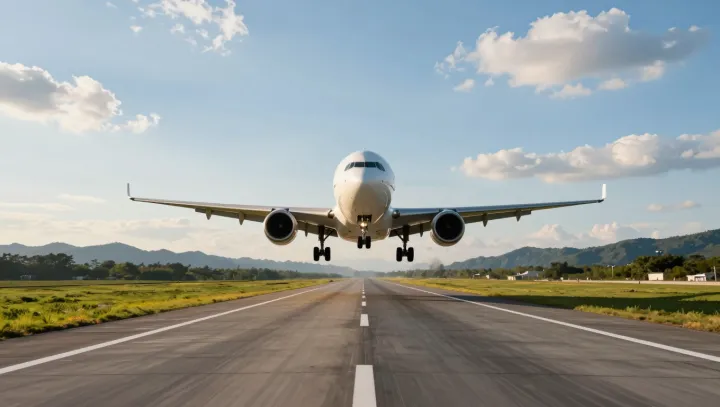
Air, not engines, makes the real decision. Over a runway, a 200‑ton jet only leaves the ground when its wings have reshaped the oncoming flow into a pressure field that can support its weight. The metal does not pound against air like a swimmer against water; instead, the wing acts as a three‑dimensional airfoil, guiding streams of air so that pressure drops above while staying relatively higher below.
The counterintuitive part is this. The wing wins by pulling, not shoving. Because of its curved upper surface and angle of attack, air accelerates over the top, and by the Bernoulli principle that faster flow carries lower static pressure, a suction region forms that supplies most of the lift. At the same time, Newton’s third law still applies: the wing deflects the airflow downward, changing its momentum, and that downward impulse matches the aircraft’s weight when climb begins.
The real trick is balance. Small changes in flap deflection or slat extension reshape the boundary layer and pressure distribution, trading drag for extra lift during takeoff. When the pressure difference integrated over each square meter of wing area equals hundreds of thousands of newtons, the aircraft is no longer rolling. It is being pulled upward by air it has carefully persuaded to get out of its way.