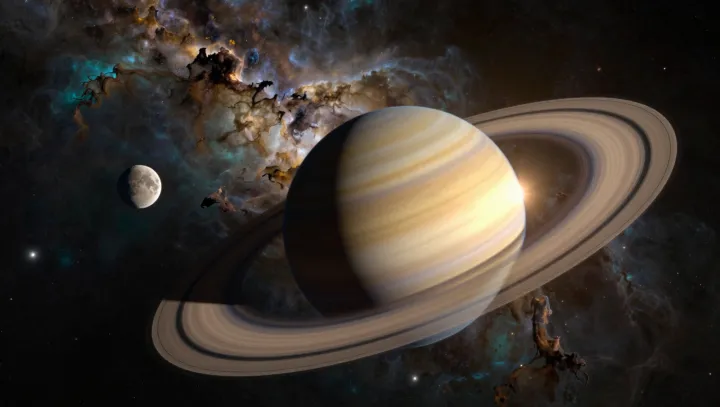
Rings are not crowns. Under sunlight, a planet can seem to wear a single, unbroken band, yet the apparent sheet is a crowded population of ice, rock, dust, and fractured debris, each body pursuing its own orbit. Nothing is welded. Their combined reflectivity and the limits of distant vision merge separate paths into one luminous stroke, a persuasive illusion made by orbital mechanics rather than by a solid structure.
Continuity is the trick. Differential gravity pulls harder on inner particles than on outer ones, while collisions trade energy and angular momentum, sorting trajectories into narrow bands and launching density waves through the disk. Order has friction. Particle size matters; fine dust responds differently to radiation pressure than larger chunks, and, within the Roche limit, tidal forces can stop loose material from accreting into a moon, while moons beyond it stir resonances that carve gaps or shepherd sharp edges.
Gravity is the editor. Resonances, collisions, and gravitational perturbations impose patterns so exact that the rings resemble planned engineering, although their architecture emerges from countless local encounters, not a blueprint. Permanence is false. Each gap and edge records a contest that never settles, while a ring system remains a moving argument among fragments, light, and pull. The rings keep arguing.