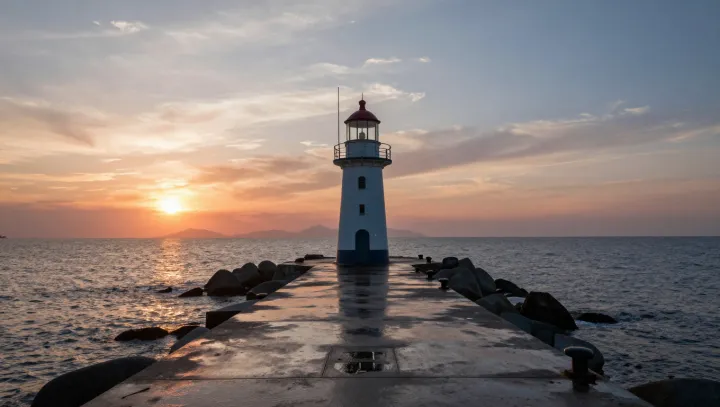
The jetty is an accomplice. Its thin, dark line presses toward the vanishing point while a skin of water on the stone catches the low sun, turning a plain view into an argument between brightness and shadow. No pigment has been added. The sky's spectral radiance remains what it was; optical geometry simply gives the eye a stern ruler against which the glow can seem more lavish.
This is less romance than design. A narrow causeway confines the field of view, so the horizon occupies a larger share of attention, and its converging edges conduct sight outward rather than letting it drift across open shore. Wet stone supplies specular reflection: light returns in concentrated patches, often beside near-black seams and crevices. Contrast does the selling. Through simultaneous contrast, adjacent darkness can make oranges and reds appear more forceful, even when their physical intensity has not changed.
The effect is persuasive, not magical. Eyes are poor meters. A wide beach may offer more sky, yet it can dilute the comparison that makes color bite; the jetty turns distance into a corridor and reflected light into a second horizon. It is visual sleight of hand: repetition, confinement, and a clash between luminous color and absorbing surface. The result is not a better sunset but a sharper encounter with one, where stone and water rehearse the sky's last flare before darkness erases the measure.