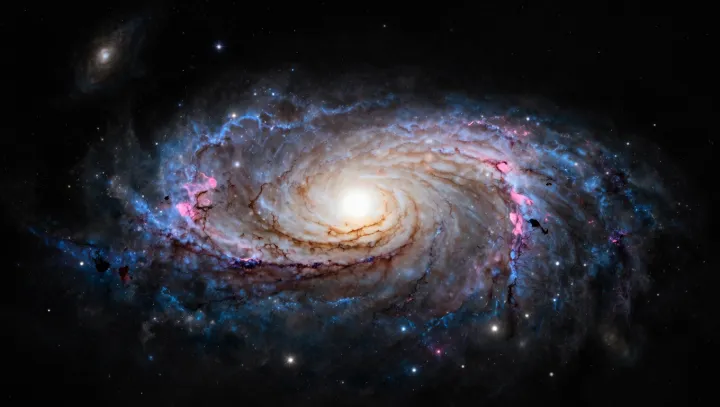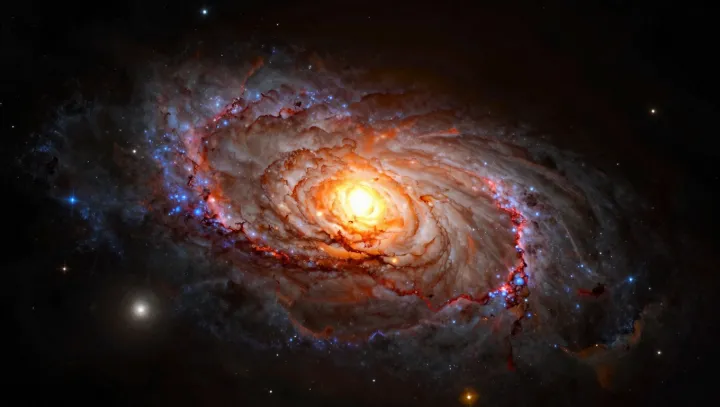
The red rim lies. Across a spiral galaxy, the apparent fire is neither combustion nor ruin: it is H-alpha emission, released after ultraviolet radiation from newborn stars ionizes surrounding hydrogen and electrons recombine. No fire is involved. Its source is stellar birth. The color is a spectral fingerprint, not a verdict on heat.
The black seams matter more. They are cold interstellar dust lanes, where grains absorb and scatter visible light while mixed gas can shield denser pockets from radiation. They erase starlight selectively. Rather than soot left by a blaze, this material belongs to the interstellar medium, a reservoir from which molecular clouds can form and gravity can compress gas toward new stars. Such grains, commonly silicate or carbon rich, do more than dim an image: they cool and protect gas.
The image is a useful trap. Red emission marks ionization near massive young stars, whose brief lives flood nearby gas with ultraviolet photons; dust marks where that radiation is blocked, not where light has died. The reading changes everything. Seen together, the glow and lanes show a galaxy conducting creation and concealment at once, with stellar feedback reshaping gas even as gravity gathers protected material into future nurseries. What looks like a wound becomes an inventory: energy, matter, and absence held in a single frame.