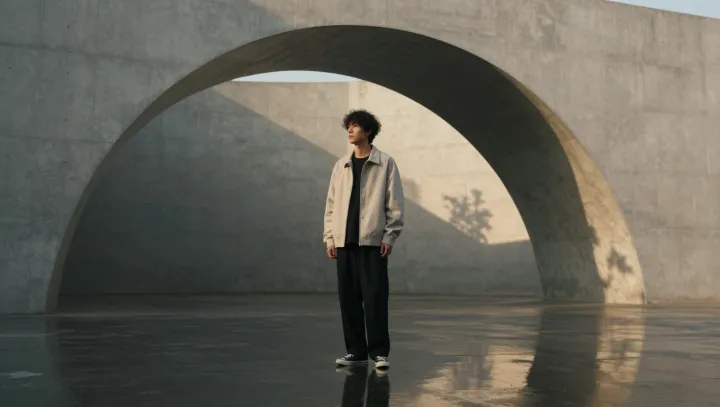
Rain makes the jacket stricter. What reads indoors as a practical layer begins to resemble a small building once water quiets the fabric's visual noise, giving seams, pockets, plackets, and collars a firmer hierarchy. The effect is not romantic. It is material physics wearing a familiar shape.
Light changes the argument. Dry cotton twill scatters illumination through its raised fibers, so its surface can look soft and visually busy; when wet, water fills gaps between fibers and changes the refractive index at the surface, reducing diffuse reflection while making darker planes appear more continuous. Specular reflection then catches along folds and edges. Suddenly, the pocket flap behaves like a projecting ledge. The collar becomes a roofline.
Weight finishes the trick. Capillary wetting draws water into the weave, increasing mass and encouraging the cloth to fall closer to the body, while damp fibers lose some of their airy irregularity. A jacket that once floated now declares boundaries. Its construction becomes legible. In rain, utility clothing briefly borrows the authority of masonry: not because it has changed its design, but because water has edited what the eye can ignore.