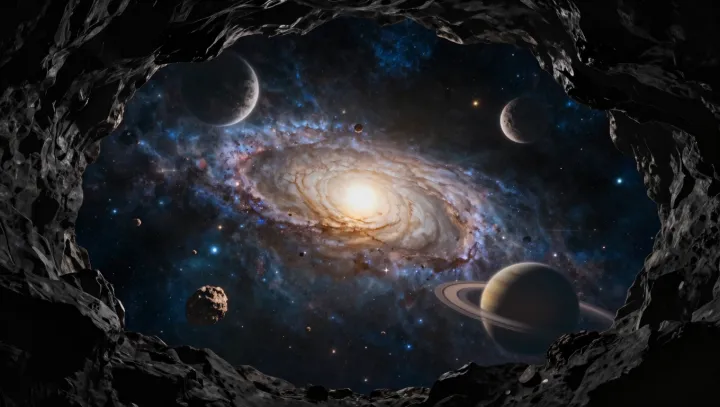
A pale smear crosses the dark, and the eye makes its first mistake: it searches for a single furnace. There is none. A galaxy's apparent glow is an aggregate signal, built from billions of stars scattered through a disk, bulge, or halo across tens of thousands of light-years.
That unity deceives. At most viewing distances, individual sources fall below angular resolution, so their photon fluxes merge into what astronomers measure as surface brightness. The math is plain. Stellar population synthesis estimates how stars of different mass, age, and chemical abundance feed that total, while dust can absorb and reroute part of the radiation. No star directs it. In nearby systems, telescopes can isolate many stars; farther out, the same physical population compresses into fewer image elements. Even a bright core is only a concentration, not the owner of the galaxy's light.
The scale is the point. A galaxy is not a lamp enlarged beyond sense; it is a census of luminous bodies whose spacing, birth rate, and extinction pattern alter the brightness profile seen from afar. The glow persists. It is the visual consequence of stellar evolution operating in bulk, where no single ember matters much and yet every one adds a measurable fraction. From distance, plurality learns to look like one.