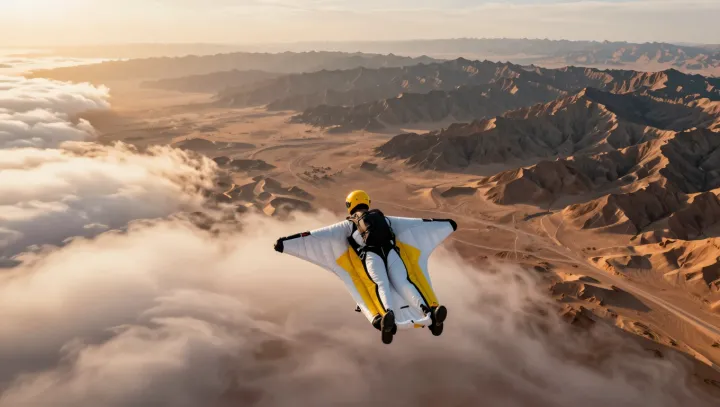
The wingsuit is less a bird's wing than a fabric argument with gravity: its panels catch the rushing air during descent, broadening a human body's surface while the ground, not any engine, supplies the energy budget. It cannot climb. What appears to be flight is a negotiated fall, written in airflow and altitude rather than feathers and flapping muscles.
That is the central correction. Lift arises when the suit's airfoil-like shape and angle of attack redirect airflow, creating an aerodynamic force with an upward component; drag rises at the same time, and the glide ratio records how much horizontal distance can be exchanged for each unit of lost height. Gravity pays the bill. The suit converts gravitational potential energy into forward speed, but cannot replenish it. A steeper descent can build airspeed, yet the lift-to-drag ratio, not bravado, sets the narrow range in which a controlled glide can exist.
The bargain remains unforgiving. Unlike an aircraft, the flyer has no propulsion, no reserve of altitude beyond what was carried into the exit, and little room for an error once terrain, wind, and body position disturb the flow; small changes can alter stability and sink rate. The physics refuses romance. Its promise is severe: horizontal reach is purchased only by vertical loss, while every second compresses the margin for correction. The margin vanishes. In the frozen silhouette of a gliding body lies the older fact: freedom here is borrowed, and gravity collects it in full.