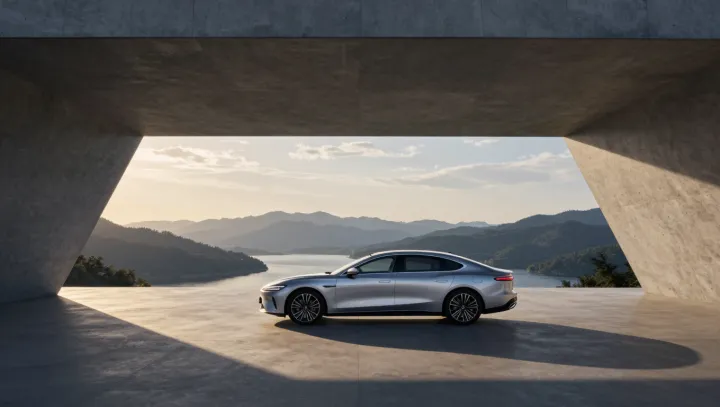
The bonnet seems to lead the bend, while the cabin follows with a fractional pause; that visual stretch hints at a mechanical truth. Calm is engineered. In a long-wheelbase grand tourer, mass sits farther from the vertical axis, so a steering correction must work against a larger yaw moment of inertia. The car resists haste. What reads as elegant proportion is also rotational leverage, written in metal.
That resistance is often mistaken for laziness. It is not. When crosswinds, cambers, or an abrupt lane change feed a yawing torque into the chassis, the same torque produces less angular acceleration when the mass moment of inertia is higher. Physics buys time. Driver inputs reach the tires at once, yet the body does not snap around them like a light, tightly packed machine; its rotation gathers more slowly, giving occupants and suspension alike a wider margin to settle.
Still, serenity carries a bill. Nothing is free. A larger polar moment can dull turn-in, and engineers must tune steering ratio, suspension compliance, damping, and tire slip angles so stability does not harden into reluctance. Wheelbase alone is no magic spell: center-of-gravity height, front-to-rear distribution, aerodynamics, and chassis stiffness all shape the result. At speed, though, measured rotation makes distance feel less like velocity than like a held breath, a machine declining the invitation to panic.