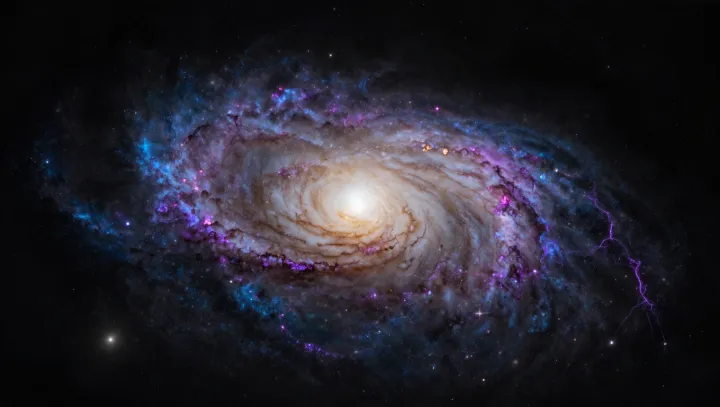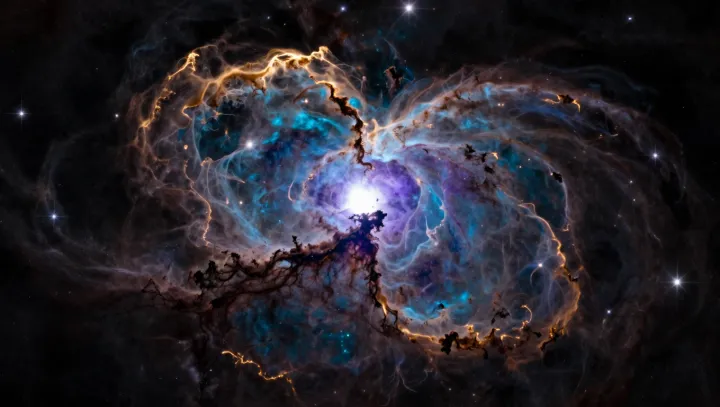
The cloud is deceptive. A nebula can seem like loose vapor drifting through darkness, yet its folds and gaps arise because gas obeys gravity, pressure, and motion with almost ruthless precision. Gravity sets terms. Where gas gathers, density rises, cooling can intensify, and a faint patch may begin collapsing toward a future star.
Radiation is the sharper chisel. Ultraviolet photons from hot stars ionize nearby hydrogen, heating it until the gas expands and drives an ionization front into colder material, where compression can build ridges, pillars, and dense knots. The front buckles. Shock waves, produced by stellar winds or stellar explosions, then sweep through the gas, transferring momentum and leaving filamentary structures behind. Instability loves edges. Rayleigh-Taylor instability can wrinkle boundaries when denser gas is pushed by lighter, faster material, turning a smooth shell into fingers and arcs.
No separate physics applies. The same gravitation that gathers a star, the same radiation pressure that moves charged gas, and the same hydrodynamics that governs shocks act across a far larger, thinner volume. Scale changes the view. What appears to be a quiet cloud is a record of forces colliding, cooling, and reforming, held in a shape that is never truly still.