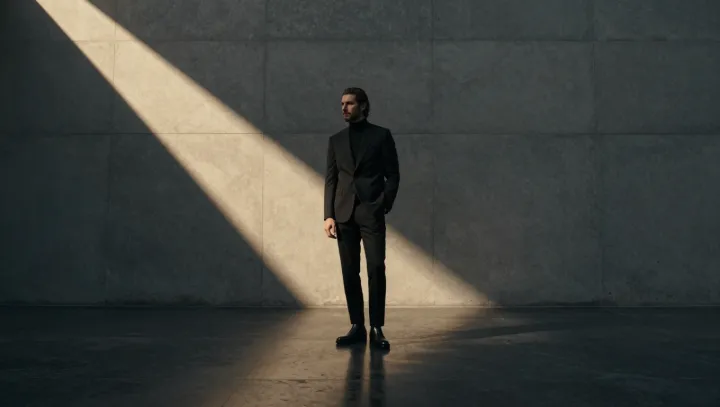
At the lapel's edge, light splits its allegiance. Black wool drinks it; black satin sends a thin signal back. The eye does not register a void. It reads a dispute between absorption and gloss, made legible by a shoulder line and a wrist.
The lazy objection is wrong: matching black need not flatten a figure; flattening occurs when luminance, contour, and surface finish all surrender at once. Tailoring prevents that surrender. A canvassed jacket builds silhouette through lapel roll, chest suppression, and a controlled break at the sleeve; these planes cast minute shadows even under soft illumination. Beside them, a matte trouser or brushed knit supplies diffuse reflection, while polished leather, silk, or coated fabric produces specular reflection. Same pigment, different optical behavior. The resulting contrast is tonal rather than chromatic, which is why it survives a restrained palette.
The trick is less about color than hierarchy. In visual perception, simultaneous contrast lets adjacent values and finishes alter one another's apparent depth; a faint highlight can make nearby black seem denser rather than lighter. Structure gives the highlight somewhere to land. Without it, reflective cloth merely advertises itself, and a monochrome outfit becomes a glare field. With it, black acquires edges, distance, and authority. Black becomes a set of materials, not a single visual fact. In the mirror, the darkest choice can look not blank, but carved from light.