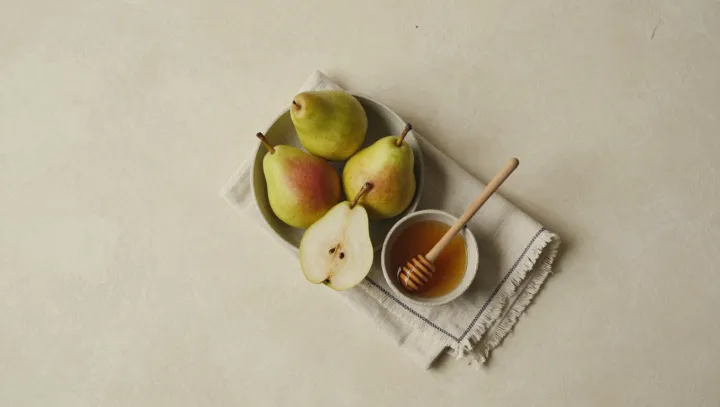
Pears carry the frame. Their matte skins absorb and scatter light across uneven surfaces, while their rounded bodies occupy enough of the picture plane to give the arrangement mass before the honey can claim attention. Honey merely flashes. Against that quiet bulk, its highlights look less like decoration than an event: a bright interruption with somewhere to land.
That hierarchy is right. Honey's appeal depends on specular reflection, the tight return of light that produces a hard gleam; without a low-sheen field beside it, the same shine spreads into visual noise. Gloss needs resistance. The pears supply it through diffuse reflection, surface roughness, and curved volume, each of which slows the eye and sets a darker baseline for the highlight. It is optical. Luminance contrast makes the honey appear cleaner and more concentrated, even when neither its color nor its quantity changes.
This still life is stricter. If honey took the anchoring role, its transparent viscosity and small bright zones would pull the image toward fragility; pears, by contrast, hold the edges and give the eye a measured route inward. Form wins first. Their silhouettes make negative space legible, and their muted finish permits the amber surface to seem almost self-lit, though the light remains shared. The fruit holds. It prevents a common error: letting a reflective accent become the subject rather than the reward for looking. Dull matter lends brilliance authority.