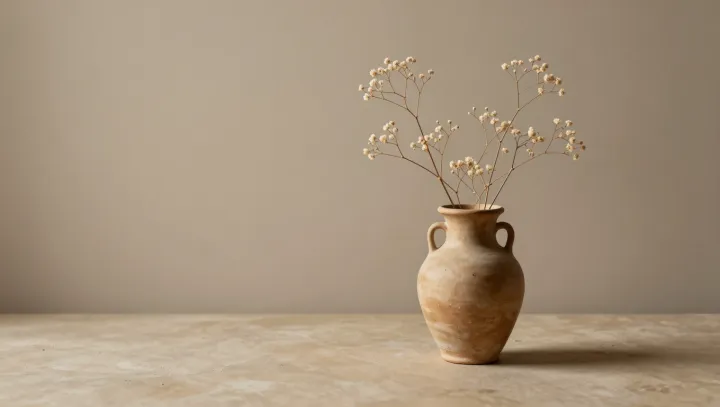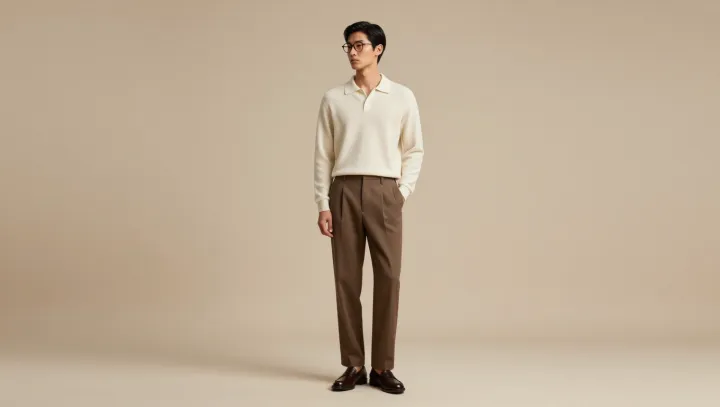
Beige absorbs the spectacle. Under a flat wash of warm, low-contrast color, the raised ribs of a sweater and the small pills at its elbow become the event, rather than evidence in a staged room. The eye slows down.
That restraint is not emptiness. In figure-ground segregation, the visual system assigns edges and surfaces into layers; when curtains, props, and theatrical shadows demand fewer claims on attention, stitch density, fiber fuzz, and uneven tension can hold the foreground. This is where feeling enters. Haptic imagery lets sight summon touch: a loose cuff implies warmth, a flattened shoulder implies repetition, and a snag can suggest a day that did not go smoothly. Dramatic settings often impose a script before the garment has spoken. Beige does the opposite. Its muted field permits visual adaptation, so the viewer notices minor shifts in cream, oat, and gray within the yarn instead of chasing a bright wall or a cinematic prop. No fantasy is required. What registers is use: friction at the wrist, compression at the sleeve, softness surviving wear.
The effect is quietly radical. Fashion imagery often treats emotion as a product of excess, yet a neutral ground removes the alibi of drama and asks whether material alone can bear memory. It often can. Knitwear records contact through stretch recovery, abrasion, and pilling; a beige backdrop neither excuses those marks nor turns them into museum relics. It leaves a plain question hanging in the air: when nothing distracts us, are we seeing the sweater, or the life imagined inside it?